
General
Unlocking Value: Why Smaller, Smarter, Cheaper SLMs Win Niche AI in 2026
The era of 'bigger is better' in AI is ending. Small Language Models (SLMs) are poised to dramatically reduce compute, deployment, and energy costs for specialized applications by 2026, delivering unparalleled efficiency and performance.
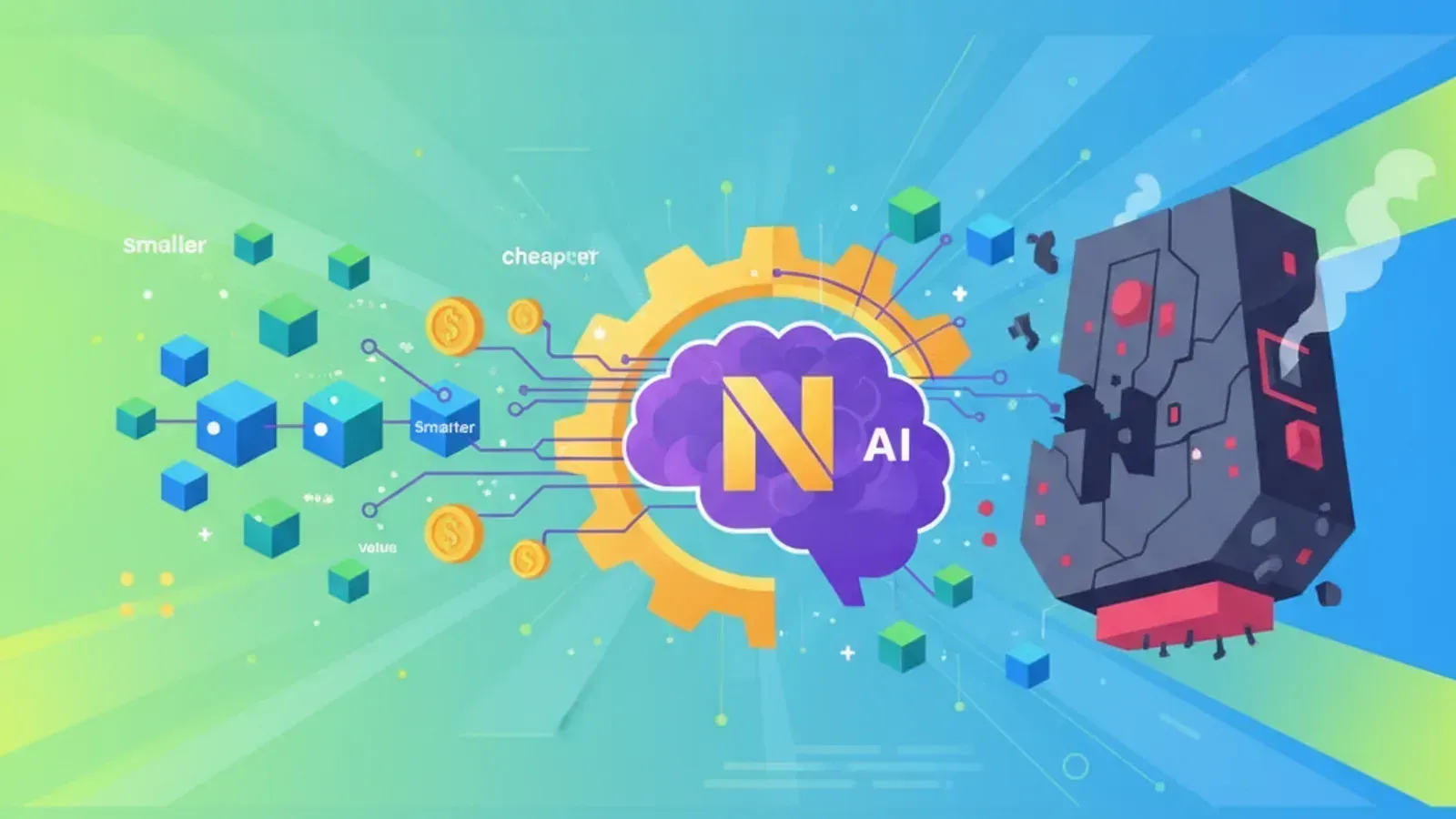
The conversation around Artificial Intelligence often fixates on monumental models, the ones with trillions of parameters that promise to do everything for everyone. But for most real-world applications, especially those focused on specific business problems, this 'bigger is better' mindset is a costly illusion. We believe the true revolution for specific AI applications will be driven by smaller, smarter, cheaper solutions: Small Language Models (SLMs) are set to redefine the landscape by 2026.
At Kraavon, we partner with founders and product teams to ship premium digital products. We see firsthand how the right tools, precisely applied, deliver disproportionate value. This is exactly what SLMs offer. They are not watered-down versions of their larger counterparts. Instead, they are purpose-built powerhouses designed for efficiency, accuracy, and cost-effectiveness in niche domains. This shift is not just an incremental improvement. It is a fundamental re-evaluation of how we build and deploy AI, challenging conventional wisdom about scale and complexity.
The Shifting Sands of AI: Beyond General Intelligence
Large Language Models, or LLMs, have certainly captured our collective imagination. They can generate creative text, answer complex questions, and even write code across a vast array of topics. Their general intelligence is impressive. However, this broad capability comes at a significant price. The computational resources required to train and run these behemoths are immense. This impacts everything from energy consumption to infrastructure costs.
For many specialized applications, the generalist nature of LLMs becomes a drawback. A model trained on the entire internet might struggle with the specific jargon of, say, medical billing or highly specialized legal documentation without extensive, expensive fine-tuning. Furthermore, carrying around all that general knowledge for a very specific task is incredibly inefficient. It is like using a supercomputer to calculate simple arithmetic.
While powerful, large language models carry inherent overhead for niche tasks. They demand significant compute for training and inference, large memory footprints, and often require substantial data filtering to achieve domain-specific accuracy. This translates directly to higher operational costs and environmental impact.
This leads to a critical realization for product teams: why pay for capabilities you do not need? Why incur the operational costs of a general-purpose model when your problem is acutely specific? The industry is now moving towards more tailored solutions. These solutions promise to deliver superior results for targeted problems, all while being dramatically more economical.
This shift is not about abandoning LLMs entirely. Instead, it is about strategic application. It is about understanding that different problems demand different tools. For niche applications, the path to innovation, and profitability, lies in precision. It lies in models built for purpose, not for breadth. This is where SLMs shine, offering a clear advantage for product teams aiming for efficiency and impact.
Unpacking the "Small" in Small Language Models (SLMs)
Small Language Models are exactly what they sound like: AI models with fewer parameters than their colossal LLM cousins. But 'small' does not mean 'less capable'. It means 'more focused'. SLMs are often trained on highly specialized datasets, making them experts in a narrow domain. They are not trying to be a jack-of-all-trades. They are mastering one specific trade, with remarkable precision and efficiency.
The key characteristics of SLMs go beyond just parameter count. They often feature optimized architectures, designed for faster inference and lower memory usage. Their training data is carefully curated for specific tasks, leading to higher relevance and accuracy within their designated scope. This focused approach reduces the chance of 'hallucinations' or irrelevant outputs, a common challenge with more general models.
- Faster Inference: With fewer parameters, SLMs can process requests much quicker. This is crucial for real-time applications where latency is a critical factor, directly improving user experience and system responsiveness.
- Lower Memory Footprint: Their compact size means SLMs require significantly less memory. This allows them to run on less powerful hardware, including edge devices, without sacrificing performance, opening new deployment possibilities.
- Higher Accuracy on Specific Tasks: By focusing on a narrow domain and specialized data, SLMs achieve superior accuracy for their intended purpose. They understand the nuances and context of their niche better than a generalist model ever could.
- Reduced Training Time: Fine-tuning an SLM on a new, specialized dataset takes considerably less time and computational power. This speeds up development cycles and lowers the cost of model iteration and improvement.
- Enhanced Data Privacy: Running SLMs on local or edge devices allows data to be processed without ever leaving the user's environment. This significantly boosts privacy and security, especially vital in sensitive industries like healthcare or finance.
This contrast with LLMs highlights a fundamental shift in strategy. Instead of brute-forcing problems with massive, general models, we can now precisely engineer solutions with SLMs. This precision delivers not only better performance for specific tasks but also unlocks significant operational and cost efficiencies. It is a paradigm where intelligence is measured by utility and efficiency, not just by sheer size.
Embracing SLMs means recognizing that complexity does not always equate to capability. Often, elegant simplicity, when perfectly aligned with a problem, yields the most profound results. This is the core principle driving the rapid adoption of SLMs across various industries. It is about working smarter, not just harder, in the world of AI development and deployment.

Efficiency comes from focus. SLMs are precision tools in a world of general-purpose machines.
The Cost Revolution for Niche Apps by 2026
The biggest differentiator for Small Language Models, beyond their focused intelligence, is their profound impact on cost. By 2026, we expect this impact to become the driving force behind their widespread adoption for niche applications. This revolution touches compute, deployment, and energy expenses. It makes advanced AI accessible and sustainable for a much broader range of businesses and product ideas.
Compute Costs: The Efficiency Edge
The training and inference phases are where AI models rack up their highest compute bills. LLMs require vast GPU clusters and take weeks or months to pre-train. Even fine-tuning them is a resource-intensive task. SLMs fundamentally alter this equation. They are often built upon existing, smaller foundation models, then fine-tuned with highly specific datasets. This transfer learning approach drastically reduces the computational burden.
Think about the data requirements. An LLM needs massive, diverse datasets to achieve its general intelligence. An SLM, in contrast, thrives on smaller, meticulously curated datasets that are directly relevant to its niche. This means fewer gigabytes of storage, less data transfer, and significantly fewer epochs during fine-tuning. The result is a dramatic reduction in the computational cycles, and thus, the cost, associated with model development and iteration.
- Strategic Data Curation: Focus on collecting and cleaning only the most relevant data for the specific niche. This reduces dataset size and improves model focus, cutting storage and processing costs.
- Leveraging Transfer Learning: Start with a pre-trained, smaller base model and adapt it. This skips the resource-intensive process of training from scratch, saving immense compute time and energy.
- Aggressive Model Pruning and Quantization: After initial fine-tuning, techniques like pruning (removing less important connections) and quantization (reducing numerical precision) can further shrink the model. This makes it more efficient for deployment without significant performance loss.
- Optimized Inference Engines: Deploy SLMs with highly optimized inference engines. These engines are tailored to the model's architecture, ensuring maximum performance on minimal hardware, further reducing runtime compute costs per query.
# Pseudo-code for fine-tuning a small language model

import torch
from transformers import AutoModelForSequenceClassification, AutoTokenizer
from datasets import loaddataset

# 1. Load a smaller pre-trained model and tokenizer
modelname = "distilbert-base-uncased"
tokenizer = AutoTokenizer.frompretrained(modelname)
model = AutoModelForSequenceClassification.frompretrained(modelname, numlabels=2)

# 2. Load and prepare your small, niche dataset
dataset = loaddataset("json", datafiles="medicalnotessentiment.json")
def tokenizefunction(examples):
 return tokenizer(examples["text"], padding="maxlength", truncation=True)
tokenizeddataset = dataset.map(tokenizefunction, batched=True)

# 3. Configure training arguments for efficiency
trainingargs = {
 "outputdir": "./results",
 "numtrainepochs": 3, # Fewer epochs for focused fine-tuning
 "perdevicetrainbatchsize": 16,
 "perdeviceevalbatchsize": 16,
 "warmupsteps": 500,
 "weightdecay": 0.01,
 "loggingdir": "./logs",
 "loggingsteps": 100
}

# 4. Train the model on your specific task
# Trainer(model=model, args=trainingargs, traindataset=tokenizeddataset["train"], ...).train()
print("Model fine-tuning process initiated with a specialized dataset...")
Deployment Costs: Reaching the Edge
Once a model is trained, it needs to be deployed. For LLMs, this often means powerful cloud GPUs, specialized infrastructure, and significant ongoing operational expenses. SLMs shatter this barrier. Their smaller size means they can run efficiently on less powerful hardware. This includes standard CPUs, mobile devices, and even tiny microcontrollers at the edge of the network. This flexibility profoundly impacts deployment costs.
The ability to deploy on-device or at the edge reduces reliance on centralized cloud infrastructure. It cuts down network latency, which is crucial for real-time applications. Moreover, it significantly lowers data transfer costs, as processing happens closer to the data source. For products requiring offline capabilities or stringent privacy, edge deployment with SLMs is not just cost-effective, it is often the only viable solution.
Deploying SLMs at the edge (on-device, local servers) drastically reduces dependence on cloud resources. This lowers ongoing infrastructure costs, improves data privacy by keeping data local, and enhances user experience through reduced latency and offline functionality. It is a game-changer for many product categories.
Scalability with SLMs also becomes more economical for niche applications. Instead of scaling up massive cloud instances, teams can scale out with numerous, less expensive edge devices. This distributed approach provides resilience and often superior performance for localized tasks. It democratizes access to sophisticated AI, moving it from specialized data centers into the hands of everyday users and devices.
Energy Costs: A Sustainable Future
The environmental impact of AI is a growing concern. Training and running large models consume vast amounts of electricity, contributing to carbon emissions. This is where SLMs offer a compelling advantage. Directly correlated with reduced compute and deployment requirements, their energy footprint is substantially smaller. A smaller model means fewer calculations, which means less power drawn from the grid.
This reduction in energy consumption is not just an environmental benefit. It translates directly into lower operational expenses for businesses. As energy costs continue to fluctuate, and as companies increasingly prioritize sustainability, the economic incentive to adopt energy-efficient AI solutions like SLMs will only grow stronger. It becomes a matter of both corporate responsibility and smart financial planning.
Adopting SLMs is a proactive step towards building more sustainable technology. It aligns with global efforts to reduce carbon footprints and promote greener computing. For product teams, this means building future-proof solutions. Solutions that are not only performant and cost-effective but also environmentally conscious. It is a win-win situation, delivering both economic and ecological benefits for the long term.

SLMs offer a path to greener, more sustainable AI, reducing both costs and environmental impact.
Realizing the Potential: Niche Applications Transformed by SLMs
The theoretical benefits of SLMs are compelling, but their true power lies in their practical application. By 2026, we foresee these smaller, smarter, cheaper models transforming various niche sectors. They will enable new product experiences that were previously too expensive or technically complex to achieve with larger models. This is about unlocking value where it matters most, in very specific contexts.
Hyper-Specialized Customer Support
Imagine a customer support chatbot that is not just conversational, but an expert in your specific product line. SLMs can be fine-tuned on an organization's internal documentation, product manuals, and customer interaction logs. This creates a bot that understands the nuances of specific queries, provides accurate solutions, and avoids generic, unhelpful responses. It moves beyond simple FAQ bots to true, domain-specific assistants.
The accuracy of such a specialized SLM far surpasses a general LLM attempting to answer highly specific support questions. This leads to higher customer satisfaction and reduces the burden on human support agents, significantly lowering operational costs. It is about delivering instant, expert-level support that feels personalized and effective, rather than frustratingly vague.
On-Device, Privacy-First AI
With SLMs, sensitive data can be processed directly on a user's device, without ever being sent to the cloud. This is a monumental leap for privacy. Consider applications in healthcare, finance, or personal productivity, where data security is paramount. A small model analyzing health data on a wearable, or summarizing meeting notes on a laptop, offers robust privacy guarantees that cloud-based solutions cannot match.
This capability opens doors for innovative products where local processing is a core feature. Think of smart home devices that truly keep your data private, or enterprise tools that perform complex analyses without sensitive information ever leaving the corporate network. It is a powerful differentiator for products that prioritize user trust and data sovereignty. We constantly think about building digital products that respect user privacy, a philosophy often enabled by these technological shifts. You can learn more about [our approach to digital products](/blog).
Contextual Content Generation and Summarization
While LLMs excel at creative writing, SLMs can provide precise, factual content generation for specific tasks. This includes automating report generation based on structured data, summarizing legal documents with strict adherence to facts, or generating medical notes from dictation. Their training on domain-specific texts ensures accuracy and relevance, minimizing the need for human oversight and correction.
Imagine an SLM trained exclusively on financial reports. It could accurately extract key figures, identify trends, and generate executive summaries with high confidence. This is not about writing a novel. It is about automating high-volume, accuracy-critical content tasks. It drastically reduces the time and effort involved in information processing and dissemination within specialized industries.
Vertical-Specific Code Generation and Assistance
For developers, an SLM trained on a specific programming language, framework, or even an internal codebase can be incredibly powerful. It can generate boilerplate code for a particular architectural pattern, suggest fixes for common bugs within a specific library, or translate code snippets between closely related languages. This is far more effective than a general code generator trying to cover every possible scenario.
These specialized coding assistants accelerate development cycles and improve code quality by enforcing best practices specific to a project or team. They become an invaluable tool for maintaining consistency and boosting productivity in highly specialized development environments. It allows engineers to focus on complex problem-solving rather than repetitive coding tasks, driving innovation forward.

SLMs can be precision-engineered to assist with highly specific coding tasks, enhancing developer productivity.
Navigating the New Landscape: Challenges and Strategic Considerations
While the promise of SLMs is immense, their effective implementation is not without its challenges. The shift requires a thoughtful approach. It demands strategic decision-making from product teams and strong execution from engineering groups. Successfully leveraging SLMs means understanding where they fit best and how to best prepare them for their specific tasks.
One primary challenge is data curation. While SLMs require less data overall, the quality and relevance of that data become even more critical. Garbage in, garbage out, as the saying goes. Investing in clean, precise, and domain-specific datasets is paramount for an SLM to achieve its full potential. This is not a task to be underestimated. It requires careful planning and robust data pipelines.
Another consideration is identifying the right niche. Not every AI problem is best solved by an SLM. General creative tasks or open-ended conversations might still be better suited for larger, broader models. The art lies in distinguishing between problems that benefit from broad intelligence and those that thrive on focused expertise. This requires deep understanding of both the business problem and the capabilities of different AI architectures. It is a strategic choice, not a blanket solution.
Finally, the engineering challenge of building, deploying, and maintaining these specialized models effectively is significant. It requires expertise in model optimization, edge deployment, and MLOps. Kraavon exists to bridge these gaps. We ensure that the strategic vision translates into a tangible, premium product. We ensure that the technical complexity is managed with senior-level precision, allowing teams to reap the benefits of SLMs without getting bogged down in implementation details.
Our senior teams move quickly from strategy to a shipped product, ensuring context never gets lost between design and code. Every engagement is built around your product, not a template. We focus on building deliverable systems that your team can own long after we are gone. This approach is perfectly suited for the nuanced development required to deploy the next generation of smaller, smarter, cheaper AI solutions. We help teams navigate the complexities, ensuring they build products that truly make an impact.

From strategy to shipment, Kraavon partners with teams to build effective, innovative products, including specialized AI solutions.
The future of AI for niche applications is not about chasing the biggest models. It is about pursuing the most efficient, most accurate, and most cost-effective solutions. Small Language Models represent this future. They offer a tangible path to dramatically reduced compute, deployment, and energy costs. They unlock new possibilities for product innovation across countless industries.
By 2026, the cost revolution driven by SLMs will be undeniable. Product teams that embrace this shift will be the ones building smarter, more sustainable, and ultimately, more successful products. This is an era where precision beats sheer scale. It is an opportunity to redefine what is possible with AI, making it more accessible and impactful than ever before. It is time to think smaller to achieve bigger results.
The future of efficient, impactful AI is here. Let's discuss how Small Language Models can transform your product and significantly reduce your operational costs. Partner with Kraavon to turn these possibilities into real-world solutions.