
Development
GenAI-Assisted Modernisation: Rebuilding Legacy Products for Scalable Growth
Many businesses find themselves held captive by ageing software systems. Discover how GenAI offers a pragmatic path to legacy modernisation, transforming outdated technology into agile, scalable products.
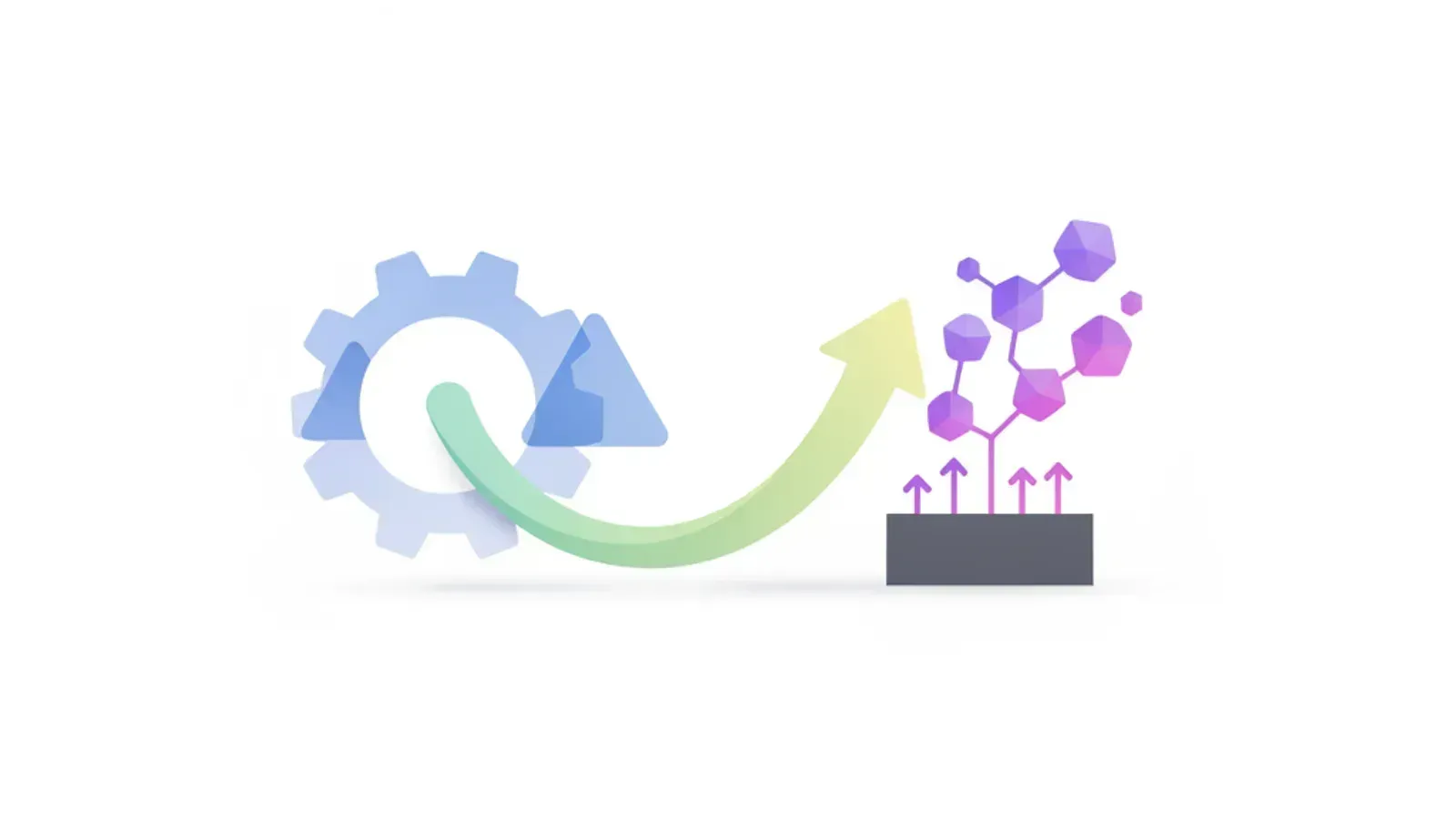
Imagine a thriving, ambitious company, let's call them 'InnovateTech'. They had a product that users loved, but beneath the surface, a monster lurked: a decades-old software system, a monolith of tangled code and forgotten documentation. Every new feature request felt like untangling a ball of yarn after a cat's playful rampage. This is the reality for countless businesses navigating the urgent need for legacy modernisation. They know their systems are slowing them down, but the thought of replacing them feels like an insurmountable challenge.
InnovateTech's product team felt the pressure. Their competitors were launching features at lightning speed, powered by modern, flexible architectures. InnovateTech, however, was stuck in a cycle of endless bug fixes and painfully slow development cycles. This wasn't just a technical problem; it was a business problem, stifling innovation and blocking crucial market opportunities.
The silent killer wasn't a sudden, catastrophic failure, but a slow erosion of competitive edge. Their legacy platform was steadily draining resources, both human and financial. It prevented the quick pivots and scalable growth that today's market demands.
The hidden costs of standing still
The decision to undertake legacy modernisation often comes too late. Companies wait until the pain becomes unbearable. The costs of maintaining an outdated system are often underestimated, hidden in plain sight.
- Slow development cycles: Adding new features or making simple changes takes disproportionately long, costing time and money.
- Increased security risks: Older systems often lack modern security protocols and are harder to patch against emerging threats, leaving sensitive data vulnerable.
- High maintenance costs: Finding engineers with expertise in archaic languages or frameworks becomes increasingly difficult and expensive.
- Lack of scalability: Monolithic architectures struggle to handle increased user loads or data volumes without significant performance degradation.
- Integration challenges: Connecting legacy systems with new third-party services or APIs is complex, if not impossible.
- Talent retention issues: Modern engineers prefer working with contemporary technologies; legacy codebases can lead to low morale and high turnover.
- Blocked innovation: The inability to quickly test new ideas or adopt cutting-edge technologies means falling behind competitors.
These factors don't just impact the engineering team. They ripple outwards, affecting product managers who can't deliver, sales teams who can't promise new features, and ultimately, the entire business's ability to compete and grow.
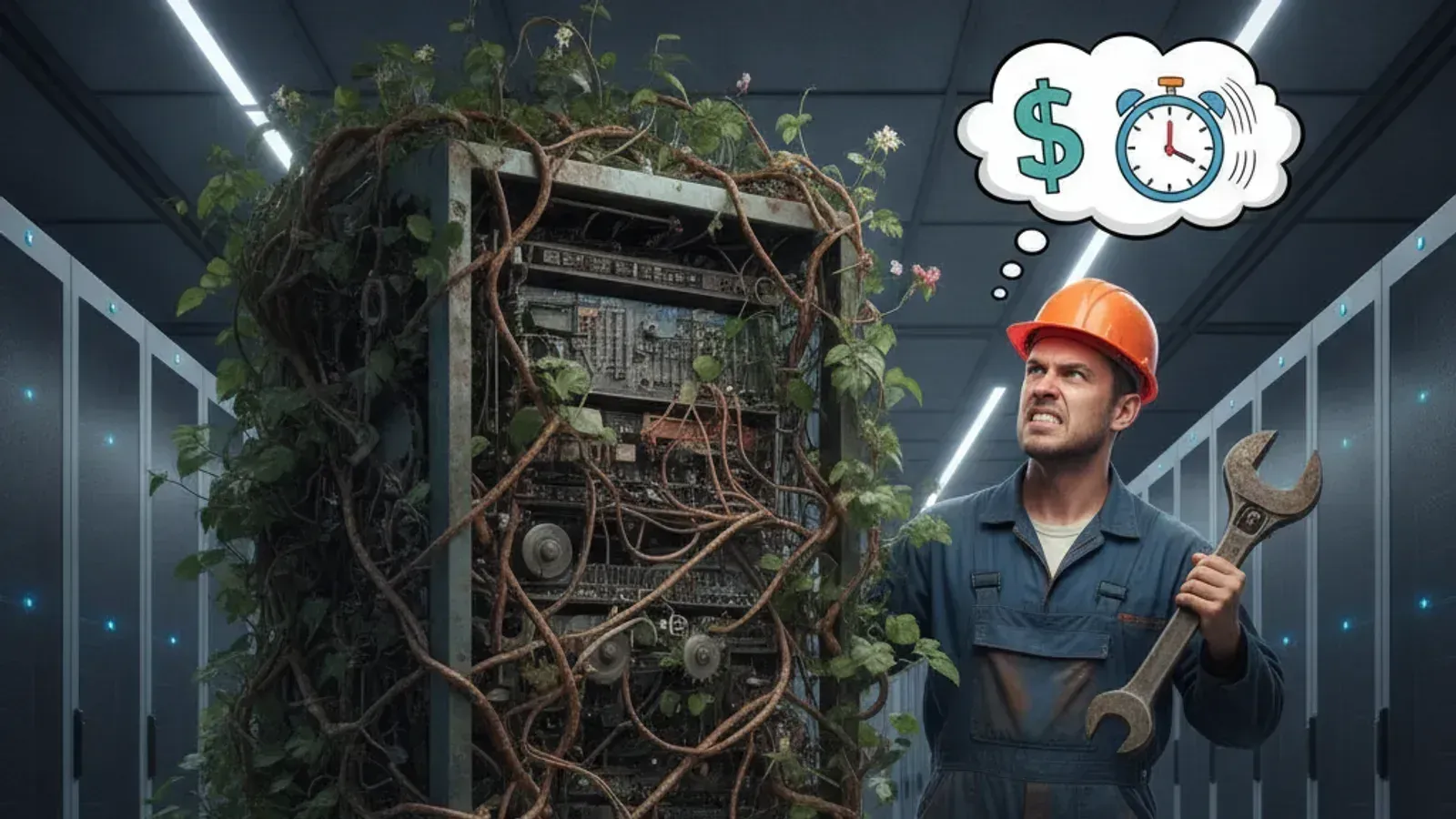
The constant struggle of maintaining a legacy system amidst a modern landscape.
The pitfalls of the "big bang" rewrite
For decades, the standard advice for dealing with a severely outdated system was often a complete rewrite, the infamous "big bang" approach. The idea was simple: build a brand-new system from scratch, replacing the old one entirely. In theory, it sounds appealing, a fresh start, free from the baggage of the past.
In reality, big-bang rewrites have a notoriously high failure rate. They are incredibly expensive, time-consuming, and often lead to projects that never ship. The business keeps running on the old system while the new one is built in secret. This means the target keeps moving. Requirements change, key personnel leave, and the new system becomes outdated before it even sees the light of day. It is a gamble few businesses can afford to lose.
A more pragmatic, lower-risk path involves incremental modernisation. This approach breaks the large problem into smaller, manageable chunks. It allows businesses to deliver value continuously, mitigate risk, and learn along the way. But even incremental modernisation can be slow, especially when dealing with undocumented, complex codebases. This is precisely where Generative AI (GenAI) steps in, changing the game for legacy modernisation.
Where GenAI truly transforms legacy modernisation
GenAI is not a magic wand that will instantly transform your old systems into shiny new ones. It is, however, an incredibly powerful accelerator, a co-pilot for engineers tackling the most daunting parts of legacy modernisation. It excels at tasks that are repetitive, pattern-based, and data-intensive, which are unfortunately abundant in legacy codebases.
Understanding the unknown: code comprehension
One of the biggest hurdles in modernising legacy systems is simply understanding what the existing code does. Imagine inheriting a million lines of code written by people who left the company years ago, with sparse comments and no up-to-date documentation. This is where GenAI truly shines. Large Language Models (LLMs) can process vast amounts of code, summarise its intent, and even generate documentation.
GenAI can analyse functions, classes, and modules, providing plain-language explanations of their purpose and behaviour. It can identify dead code, redundant logic, and potential areas for refactoring. This drastically reduces the time engineers spend reverse-engineering the system, allowing them to focus on building the future rather than deciphering the past.
Mapping the maze: dependency analysis
In a monolithic application, components are often tightly coupled. Changing one part can have unforeseen consequences elsewhere. GenAI can help map these complex dependencies, visualising how different parts of the system interact. This is invaluable for planning an incremental migration, allowing teams to isolate and extract services without breaking the entire application.
- Code scanning: GenAI tools scan the entire codebase to identify function calls, class instantiations, and module imports.
- Dependency graph generation: It constructs a visual graph showing how different components rely on each other.
- Impact analysis: Engineers can query the GenAI model to understand the potential impact of modifying or removing a specific component.
- Service extraction proposals: Based on dependency analysis, GenAI can suggest logical boundaries for new microservices or modules, making the strangler pattern more effective.
Accelerating migration and test generation
Once parts of the system are understood and dependencies mapped, GenAI can accelerate the actual migration work. It can assist in translating code from older languages or frameworks to newer ones, or generate boilerplate code for new services. While it won't write perfect production code, it can provide a significant head start, handling much of the tedious, repetitive coding.
Crucially, GenAI can also generate comprehensive test suites for existing legacy code. This is vital for ensuring that as parts of the system are refactored or migrated, their original behaviour is preserved. Generating tests manually for a massive, undocumented codebase is often impractical. GenAI can analyse the code's logic and generate unit, integration, and even end-to-end tests, dramatically increasing confidence during the modernisation process.
# GenAI-generated unit test example

def testcalculatetotalpricewithdiscount():
 # Simulate legacy pricing logic
 items = [
 {'name': 'Laptop', 'price': 1200, 'quantity': 1},
 {'name': 'Mouse', 'price': 25, 'quantity': 2}
 ]
 discountcode = 'SAVE10'
 expectedtotal = 1125.0 # (1200 + 50) * 0.9 = 1125

 # Assuming a function `calculatetotalprice` exists in the legacy system
 actualtotal = legacypricingsystem.calculatetotalprice(items, discountcode)
 assert actualtotal == expectedtotal, f"Expected {expectedtotal}, got {actualtotal}"

def testcalculatetotalpricenodiscount():
 items = [
 {'name': 'Keyboard', 'price': 75, 'quantity': 1}
 ]
 expectedtotal = 75.0
 actualtotal = legacypricingsystem.calculatetotalprice(items, None)
 assert actualtotal == expectedtotal, f"Expected {expectedtotal}, got {actualtotal}"
This capability alone significantly de-risks the modernisation effort. Engineers can make changes with the assurance that automated tests will catch regressions, preserving the critical business logic that the legacy system delivers. This accelerates the iterative development cycle, making legacy modernisation faster and safer.

GenAI acts as a powerful co-pilot, accelerating code analysis and suggesting improvements.
The limits of AI: where human judgment remains paramount
While GenAI is a formidable ally in legacy modernisation, it is crucial to understand its limitations. GenAI is a tool, not a decision-maker. It accelerates tasks and provides insights, but it does not remove the need for experienced, senior engineering judgment. Relying solely on AI without human oversight can lead to disastrous consequences.
Architectural decisions and strategic vision
GenAI can suggest refactorings or microservice boundaries, but the overarching architectural vision must come from human architects and product leaders. Deciding whether to move to a serverless architecture, adopt event-driven patterns, or choose specific cloud providers requires deep understanding of business goals, operational constraints, and future scalability needs. These strategic choices are beyond the scope of current AI capabilities.
Data integrity and migration strategy
Migrating critical business data from old databases to new ones is perhaps the riskiest part of any modernisation effort. GenAI can help with schema translation or data mapping, but ensuring data integrity, consistency, and completeness throughout the migration process requires meticulous human planning, validation, and oversight. A single error in data migration can have catastrophic consequences for a business.
Production reliability and security
Even if GenAI generates code and tests, experienced engineers are essential for hardening systems for production. This includes setting up robust monitoring and alerting, implementing comprehensive security measures, ensuring high availability, and planning for disaster recovery. AI can assist in identifying vulnerabilities or suggesting monitoring points, but the ultimate responsibility for a reliable, secure production system rests with human engineers.
Think of GenAI as an incredibly skilled junior engineer or a powerful analysis tool. It can do much of the heavy lifting, but it still needs clear direction, constant supervision, and the strategic guidance of senior experts. It accelerates the journey of legacy modernisation, but it doesn't take the wheel entirely.
A practical path to GenAI-assisted legacy modernisation
So, how does a business practically embark on a GenAI-assisted legacy modernisation journey? It requires a structured, iterative approach that leverages AI's strengths while mitigating its weaknesses. Here is a proven pathway:
Step 1: comprehensive audit and discovery
Start by understanding the beast. Use GenAI tools to scan the entire legacy codebase. Generate summaries of functions, identify modules, and map out dependencies. Focus on understanding the core business logic embedded in the old system. This initial phase helps create a clear picture of what you have and what needs to change. Document everything possible, using AI to generate initial drafts of technical specifications.
Step 2: prioritise and strategise
With the audit complete, identify the areas that offer the highest business value and the lowest risk for migration. This might be a module that is frequently changed, a performance bottleneck, or a feature that new talent finds particularly difficult to maintain. Develop a clear architectural vision for the new system, even if it is built incrementally. This strategic roadmap, created by human architects, guides all subsequent GenAI-assisted work.
Step 3: incrementally strangle the monolith
Adopt the "strangler fig" pattern. Instead of a big-bang rewrite, build new services around the existing monolith. As new functionality is developed, or old functionality is rewritten, it is deployed as an independent service. Traffic is then gradually redirected from the old system to the new services. GenAI can assist in identifying the natural seams for these new services and generating the necessary integration layers.
Step 4: preserve data and behaviour
As you extract or rewrite components, ensure that the core business logic and data integrity are preserved. This is where GenAI's ability to generate comprehensive tests becomes critical. Run parallel tests, compare outputs between the old and new systems, and validate data at every step. Continuous integration and deployment practices are vital here, allowing for rapid iteration and feedback.
Step 5: harden for scale and future growth
The goal of modernisation is not just to replace old code, but to build a system that can scale and evolve. Implement robust monitoring, logging, and alerting from day one. Design for resilience and fault tolerance. Ensure the new architecture is flexible enough to accommodate future changes and new technologies. This future-proofing requires experienced engineering expertise beyond what GenAI can provide autonomously.

The 'strangler fig' pattern: incrementally replacing legacy functionality with new services.
Kraavon: your partner in intelligent modernisation
At Kraavon, we understand the immense challenge and opportunity that legacy modernisation presents. We partner with founders and product teams who are stuck on ageing systems, helping them move from strategic intent to shipped, scalable products. Our approach combines the speed and efficiency of GenAI tools with the deep, production-grade engineering expertise that only senior teams possess.
We don't just hand off files; we become an integral part of your team, ensuring that decisions stay fast and context is never lost between design and code. Our small, senior teams leverage GenAI to accelerate code understanding, dependency mapping, and test generation, but always with the critical human judgment required for architectural integrity, data migration, and overall system reliability. We have real experience re-platforming complex legacy systems into agile, scalable solutions, ensuring your investment truly pays off.
Every engagement is built around your product, not a template. We focus on delivering tangible value, ensuring that your team owns the new system long after we are gone. We guide you through the complexities of legacy modernisation, helping you unlock scalable growth and reclaim your competitive edge.
Frequently asked questions about legacy modernisation
How long does legacy modernisation typically take?
The timeline for legacy modernisation varies significantly based on the system's size, complexity, and the chosen approach. A small, well-defined module might be modernised in a few months, while a large, intricate monolith could take several years. Incremental strategies, especially when assisted by GenAI, can deliver value within weeks or months, as opposed to multi-year big-bang projects. The key is to break it down into manageable phases, delivering continuous improvements.
How can we ensure no downtime during modernisation?
Minimising or eliminating downtime is a critical concern. Strategies include employing the "strangler fig" pattern to redirect traffic incrementally, using feature toggles to switch between old and new functionalities, and running new services in parallel with the old system for validation. Robust testing, continuous integration, and careful deployment pipelines are essential to ensure a seamless transition for users. Data migration must also be carefully planned to avoid service interruptions.
Should we rewrite our legacy system or refactor it?
This is a fundamental question. A complete rewrite (big bang) is often risky and expensive. Refactoring, which involves restructuring existing code without changing external behaviour, is a safer, more incremental path. Often, the best approach is a hybrid: strategically refactoring core components while incrementally rewriting others as new, independent services. GenAI can accelerate both refactoring analysis and the generation of new service boilerplate, making this hybrid approach more feasible and less daunting.
What specific GenAI tools are best for this process?
The landscape of GenAI tools is rapidly evolving. For code comprehension and documentation, large language models like OpenAI's GPT series or Google's Gemini, often integrated into IDEs, are powerful. Specialised code analysis tools that incorporate AI, and platforms designed for code migration or test generation, are also emerging. The best choice often depends on the specific legacy language, framework, and the team's existing tech stack. At Kraavon, we select and integrate the most effective tools to suit your unique project needs.
Don't let outdated technology hold your business back. Partner with Kraavon to navigate the complexities of legacy modernisation with confidence and accelerate your path to scalable growth. Let's discuss how GenAI-assisted engineering can transform your product.