
Development
Vibe coding got you a prototype. Here's what it takes to ship a product.
Vibe coding and AI tools are brilliant for rapid prototyping, letting you quickly see your ideas come to life. But turning that exciting prototype into a robust, reliable product that users depend on involves a whole different set of considerations.
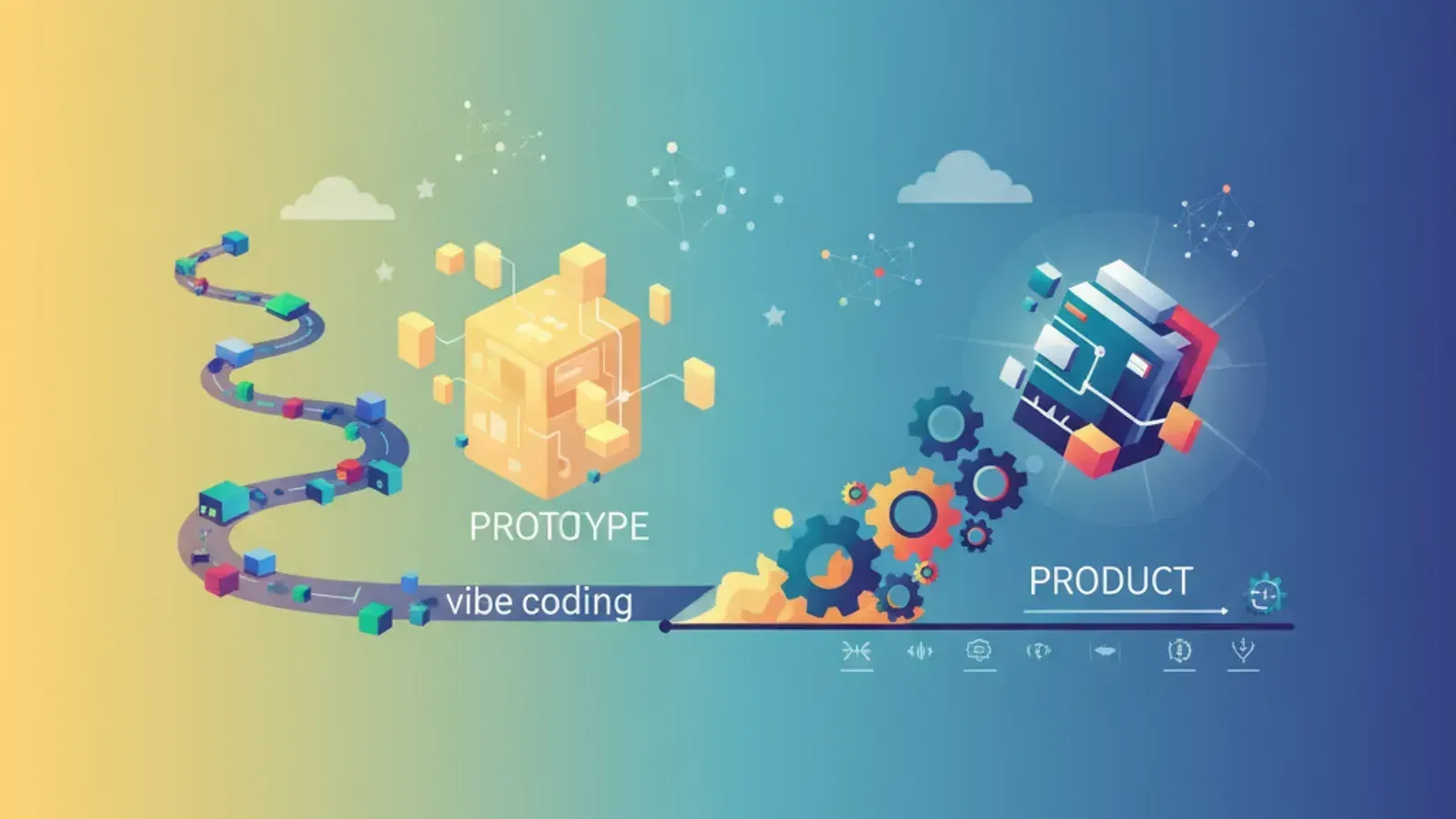
Imagine this: a flash of inspiration hits, you feed it to your favourite AI coding assistant, and within hours, sometimes minutes, you have something tangible. It is a working demo, a dazzling proof-of-concept. You have just experienced the magic of 'vibe coding', a term that perfectly captures the intuitive, rapid, almost effortless way AI tools can turn an idea into a functional prototype.
Founders often approach us, eyes gleaming, having built something impressive with these tools. They have a booking form, a simple social feed, or a data visualisation dashboard, all conjured up with remarkable speed. It is genuinely exciting, a testament to the power of modern development. But then comes the question: 'How do we get this into users' hands, reliably and at scale?' That is where the journey from a brilliant vibe-coded prototype to a shippable product truly begins.
The magic of rapid prototyping with AI
Let us be clear, Kraavon uses AI daily. We are staunch believers in its transformative power. For initial concept validation, exploring user flows, or simply getting a 'feel' for an application, AI coding tools are unparalleled. They offer incredible speed, scaffolding basic structures, and generating boilerplate code with astonishing efficiency.
This rapid prototyping capability significantly lowers the barrier to entry for innovation. You can test ideas faster, fail cheaper, and iterate more quickly than ever before. It is a genuine superpower for founders looking to validate market fit or demonstrate a concept to investors. An idea that might have taken weeks to mock up manually can now be a click-through demo in a day. This speed is invaluable for securing early buy-in and momentum.

Vibe coding can bring your ideas to life almost instantly, offering incredible speed for initial concepts.
The production chasm: where prototypes stumble
While prototypes are excellent for demonstrating functionality, they rarely possess the underlying robustness required for a product people can depend on. The gap between a flashy, functional demo and a truly shippable, production-ready system is vast. It is filled with crucial considerations that AI, left unsupervised, often glosses over.
Consider data integrity and race conditions. If your prototype has a booking system, what happens when two users try to book the same slot at the exact same millisecond? A basic prototype might allow both, creating an inconsistent and frustrating experience. A production system, however, needs database-level constraints and atomic operations to ensure only one booking succeeds, maintaining the integrity of your data.
Authentication, authorisation, and permissions are another common pitfall. A prototype might have a simple login. But what about secure password hashing, multi-factor authentication, session management, or role-based access control? How do you ensure users only see data they are permitted to see? These are complex, security-critical systems that require careful, expert implementation to prevent vulnerabilities.
- Multi-tenancy concerns: Properly isolating data for different organisations or users in a shared infrastructure.
- Handling real-world edge cases: What happens when user input is unexpected, network connections drop, or external APIs fail?
- Performance under load: A prototype might work for one user, but will it crumble for a thousand or a million concurrent users?
- Robust security measures: Beyond basic login, protecting against common web vulnerabilities, data breaches, and malicious actors.
- A codebase that is maintainable: A prototype often sacrifices long-term clarity and architecture for speed. A product needs clean, well-structured, testable code that can evolve without constant rewriting.
The cost of building a throwaway prototype and then rebuilding for production can be far higher than investing in production-grade code from the outset. As we explore in our article about a booking form vs. a product, the visible surface is just a tiny fraction of the necessary work. Production systems demand stability, scalability, and security, aspects that are often an afterthought in a quick 'vibe coding' session.
Behind the prototype's smooth surface often lies a tangle of unaddressed production challenges.
From concept to robust product: the Trimsmith story
To illustrate this difference, let us look at our work with Trimsmith, a platform designed to simplify booking and client management for barbershops. Early on, a 'vibe coded' prototype could quickly show a calendar and a booking button. It might even allow a user to select a time slot and confirm an appointment. This provides a great demo, but it does not account for the real-world complexities of running a business.
When Kraavon partnered with Trimsmith, we looked beyond the basic booking flow. A critical decision we made, right at the database level, was to implement robust booking constraints. This meant ensuring that a slot, once booked, could not be double-booked. We used database transactions and specific locking mechanisms to prevent race conditions, guaranteeing that each barber's calendar remained accurate, even under heavy load. This is a foundational element a prototype typically skips.
Another key consideration was multi-tenancy. Trimsmith needed to serve many different barber shops, each with its own clients, barbers, and schedules, all securely separated. From the very first schema design, we architected the system with multi-tenancy in mind. This meant careful data partitioning, ensuring queries were always scoped to the correct tenant, and preventing any shop from accidentally or maliciously accessing another's data. You can read more about this journey in the Trimsmith case study.
These are not merely 'optimisations' or 'nice-to-haves'. They are fundamental architectural decisions that transform a proof-of-concept into a reliable, scalable product. They ensure data integrity, provide robust security, and allow the product to grow without constant, costly re-engineering. This is the essence of shipping a durable product, not just a temporary prototype.

Building a robust product means constructing a reliable bridge from concept to scale.
Bridging the gap: AI and senior judgment working as one
The answer is not to abandon AI. Far from it. The answer is to recognise AI for what it is: an incredibly powerful tool that, when wielded by senior engineering judgment, can achieve remarkable things. It is not AI or engineers, it is AI plus senior engineering judgment. AI moves you fast, and then experienced hands make it correct and durable.
At Kraavon, we leverage AI to accelerate routine tasks, generate boilerplate, and even explore initial solution patterns. This frees our senior product engineers to focus on the truly complex challenges. They design the robust architecture, implement critical security measures, handle intricate edge cases, and ensure the codebase is maintainable and scalable. They provide the wisdom and foresight that AI, by its nature, cannot yet replicate.
This blend allows founders to enjoy the speed and innovation of AI-assisted development while gaining the peace of mind that comes from a product engineered for the real world. We use AI to get to a working prototype faster than ever, then apply our expertise to transform that prototype into a product people can trust and depend on. This ensures your product not only works, but works reliably, securely, and at scale. Learn more about our approach to bringing products to life through [product engineering](/services/product-engineering).
Frequently asked questions
Can AI build my entire application?
AI can generate significant portions of an application, particularly for common patterns and boilerplate code. However, for complex business logic, critical security implementations, bespoke architectural decisions, and ensuring robust error handling, human oversight and expert engineering are still essential. AI is a powerful assistant, not a fully autonomous developer for production-grade systems.
Why do prototypes built with AI often fail in production?
Prototypes, by design, prioritise speed and functionality over robustness. In production, they often fail due to a lack of scalability under real-world load, inadequate security measures, poor error handling, insufficient management of edge cases, and a codebase that is not designed for long-term maintenance or expansion. These are the aspects AI currently struggles to address without human guidance.
When is the right time to bring in senior engineers?
Ideally, senior engineers should be involved early, even during the strategic planning phase, to help define a robust architecture. If you have already built a prototype with AI, the best time to bring in senior engineers is once your core concept is validated and before you invest heavily in scaling or preparing for launch. They can then transform your prototype into a shippable product efficiently.
How does Kraavon leverage AI in product development?
At Kraavon, we integrate AI into our daily workflows to enhance efficiency. We use it for tasks like generating initial code structures, writing tests, and exploring different solution approaches. This allows our senior teams to dedicate their expertise to higher-value activities: designing resilient architectures, implementing sophisticated security, tackling complex business logic, and ensuring the overall production readiness of the product. It helps us deliver premium products faster.
If you have a brilliant prototype and are ready to bridge the gap to a shippable, scalable product, we are here to help. Our senior design and engineering teams work as one to bring your vision to life, reliably and efficiently.